Sunday, July 14, 2013

The Fault in our Stars by John Green


This story was heart wrenching for me to read. Hazel, the main character is has cancer but is doing well because she is on a drug that keeps the rumors in her body from growing. She was first diagnosed three years prior when she was 13. That prognosis was not good so her parents took her out of school, but her body fought through it and she survived. Because she continued to have health problems her parents let her get a GED instead of returning to high school. 

She does take a few classes at a community college but is constantly depressed. To her dismay her mother suggests that she attends a cancer support and she only agrees so that her mother will leave her alone. She does make one friend, Isaac, in the group but only because they both think the group is absurd. One day, while attending the group, Hazel notices a new boy in the group and he keeps staring at her. After the session begins she learns that the boy who keeps staring at her is Isaac's friend Augustus, who had his leg amputated because of his cancer.

From the moment that Augustus sees Hazel he is in love but she isn't so sure but they do become quick friends. She even tells Augustus about her favorite novel, An Imperial Infliction, which she has never shared with anyone before. 
There friendship soon blossoms to love but because Hazel is afraid that she will die soon she does not want Gus to feel that way about her.

As I was reading this story I longed for their to be a happy ending even though I knew there wouldn't be one. It just didn't seem fair that these two teenagers could find true love only to have it taken away. 

This would be a good book to read in a high school class. It may be sensitive to some because it is not a book that tip toes around the subject of cancer. Hazel describes in great detail what she and her parents went through. However that is not the focus of the book. This novel shows that people who have been diagnosed with cancer do not want to be pitied. They strive to have normalcy in their lives just like everyone else. 

This was a great read, but you might need some Kleenex.

Thursday, July 11, 2013

Al Capone Does My Shirts by Gennifer Choldenko


This book is another reread for me and I enjoyed reading it for a second time. This is also the second time that I have read a book this semester about a child who has a form of Autism. 

This novel is about a twelve year old boy whose family moves to Alcatraz Island in 1935 so that his disabled sister has an opportunity to attend a special school. Moose, the main character is not at all pleased that he has to leave his friends and home behind because of his sister. 

He also feels conflicted for blaming her because he knows that is not really her fault. As the novel goes on you can see how his relationship with Natalie grows. Even though he and his family don't really understand her disability they are all very protective of her, especially Moose. 

I really feel sympathetic for their mother because she tries to find every opportunity to help Natalie but ends up  unintentionally  alienating Moose. I grew up with a brother with severe asthma who was frequently in the hospital as a child. Our parents gave him a lot more attention than the rest of us and that was really hard. I understand why they did those things now that I am an adult. Like Natalie, my brother was not able to do the things that the rest of us were allowed to do because they were afraid he would get sick or hurt. It is sometimes difficult to find a balance when you are a parent of a children with and without disabilities.

Because of the time in which this story took I saw the differences in how people with disabilities were treated in the past and how they are treated now. Friends and relatives told the Flannagans that they should send Natalie to an institution. From what I learned in my few special education classes in undergrad, that was something that was frequently done at the time. Now every effort is made to keep children in regular schools and classrooms as much as possible because of laws that have been passed.

Mockingbird, a novel that I read earlier this summer is also about a girl who has a form of Autism but she is higher functioning. It was interesting to compare and contrast the two books. Both girls had a brother who was very protective. Both were also misunderstood by peers. The major difference is that Caitlin, the main character from Mockingbird, attends a regular school and Natalie has to attend a special school. If Natalie's story took place today she would probably be in a self contained class but would interact with other students at lunch, recess and specials.

I really enjoyed this book and would recommend it for use in a intermediate elementary or middle school classroom.

Wednesday, July 3, 2013

Please Ignore Vera Dietz by A.S. King


Book number five under my belt. I can't wait to start reading the next book. 

I think I'm seeing a trend now. This is the fourth book about a teenage/ preteen girl that I have read. I'm going to have to switch it up next week.

Well this is another book that I have read that deals with death. This time it is the death of Vera's best friend Charlie that is the focal point of the novel. 

Charlie and Vera and been friends and neighbors since they were very young. They both knew secrets about each others families that know one spoke about. Vera's mother, who left when she was twelve, was once a stripper. Charlie's father is an abusive alcoholic who beat his mother. 

When Charlie dies, Vera is the only person who can tell what really happened  that night to clear his name but she can't bring herself to do it. Even though that had been friends since childhood, months before Charlie died he abandoned Vera to start hanging out with the very people they had criticized since beginning high school, the kids who frequent detention. Vera sees visions of Charlie every where urging her to clear his name but the hurt she feels might force her to keep it a secret.

This is by far one of the more gritty novels that I have read this summer. This is definitely a novel that should only be read in high school because of the language used in the book. I did really enjoy it though because the main character talks like a real high school student. Another aspect that I enjoyed was the the changing narrators in the story. Even though the majority of the story is told by Vera, there are occasions when Charlie, Vera's dad, or The Pagoda give their views of what is happening.


Wednesday, June 26, 2013

The Disreputable History of Frankie Landau-Banks by E. Lockhart


I just finished the fourth book for my Adolescent Literature class and I am really enjoying these books.

The Disreputable History... is about a teenage girl, Frankie Landau-Banks. She attends a reputable boarding school that holds great importance to her father. In the beginning of her sophomore year, she begins dating a very popular senior. She and Matthew are like the perfect couple. Frankie gets along well with Matthew and his friends but she longs for something more.

Frankie notices that Matthew inexplicably has to leave her to attend various extracurricular meetings and becomes suspicious. Her father, Franklin Banks had frequently alluded to the existence of a secret society at the school. Frankie believes that Matthew an his friends are a part of this and wants desperately wants to be included. 

I really enjoyed reading about Frankie. I grew up with five brothers and often had male friends. Like Frankie, I got along well with them but never felt that I was really included simply because I was a girl. That is something that many students can relate to, the need to belong to a group. In high school the group that you belong is a part of your identity so it is very important.

I think that this book would be a great way to make women's rights or suffrage more relatable. The secret society in the story is exclusively for males even though the school had been co-ed for decades. Matthew and his friends down play any intelligent or intriguing conversation by commenting about her looks. Her family also demean her gender, though unintentional, by calling her bunny rabbit.


Wednesday, June 19, 2013

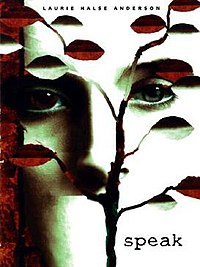
Speak by Laurie Halse Anderson


This week I read the novel Speak. This novel is about a high school freshman, Melinda Sordino. Starting high school is difficult. You leave from being on top in middle school to being at the bottom of the barrel in high school. Melinda has to adjust to these changes on her own because her friends have abandoned her and everyone else at the school glares at her and whispers behind her back.

Trying to get a social head start on their high school careers, Melinda and her friends decide to attend an end of the summer high school party. Something horrible happens to Melinda and she calls the police. Her friends and everyone at the school thinks she called to break up the party but they don't know what really happened.

Melinda is forced to suffer in silence. She blames herself at first and has no one to talk to. She has no friends and can't talk to her parents. This is how high school begins for Melinda. She must struggle within to find the strength to confront what happened to her.

I have to admit that this is not a book that I would have chosen on my own. The author conveys Melinda's feeling very well so it was very depressing to read. I would definitely only read this book in a high school class, but I don't know if I would use it as a whole group because of the subject matter. To me this seems like a really good book to have as a book study for a counseling group.

There is also a movie adaptation of this book starring Kristen Stewart. I started watching it but I couldn't finish. From what I did watch, the first 30 minutes or so, it did follow to novel pretty closely.


Wednesday, June 12, 2013

Mockingbird by Kathryn Erskine


Mockingbird is about a 5th grade girl whose brother died in a school shooting. Dealing with the loss of a loved one is difficult for any child, but Caitlin also a has Asperger's Syndrome. She understands that her brother, Devon, is gone but she does not understand the emotional aspect of it. People whom she rarely saw when Devon was alive are crying at his funeral.

If that tragedy was not bad enough, she is also at the age when students start to become more judgmental and cliquey, especially the girls. Other students in her class this that she is weird and avoid interacting with her. At the same time she really doesn't want to interact with them either.

With Devon gone, Caitlin only has her father to depend on. Devon was her sole companion and the person that she depended on the most and her father is too distraught with grief to notice that she needs him. He falls apart anytime Devon or the tragedy is mentioned.

With the help of her school counselor, Caitlin begins to make friends and tries to come to terms with Devon's death. Her budding friendship and need to find closure, she also helps her father. Her bluntness is endearing in a way because is forces her father to realize that he needs to there for Caitlin.

I loved that the author wrote this book from Caitlin's perspective. I have known and worked with students with Asperger's but I really never understood how they felt or perceived the world. While reading the book I was Caitlin saw the world through her eyes. Everything that people thought was weird about her was just how she coped with her environment. 

I think this is a great book to read as a whole class at the beginning of the year. Most schools prefer that you spend the first two weeks or more of school focusing on rules and procedures and this would be a great multicultural community building book. Through Caitlin's experiences the students could see that just because someone is different from you in any way does not mean that they should not be valued. Caitlin's classmates learned that she was a great artist.


Tuesday, June 4, 2013

The Giver by Lois Lowry

I have to admit that it has sadly been years since I have read a book for pleasure. Reading becomes a daunting task after being assigned so many text books. Hopefully this class in Adolescent Literature will change that.

That being said I have just finished reading one of my favorite books, The Giver. I first read this book over 14 years ago when I was in the seventh grade and fell in love with it. It was refreshing to read the book again  with a different perspective.

The story is about Jonas, who lives in  a seemingly Utopian society sometime in the distant future. In this community everything runs  smoothly and is almost perfect. There is no crime. Every person is polite and well-mannered (there are actually rules against rudeness.) There is no difference between race or gender and everyone is treated equally.

Jonas lives happily and carefree just as everyone else in the community until his job is selected during the ceremony of Twelves. He is given the most honorable job of the community. However, with this prestige he comes to find that his life and everything that he knows is not what it seems.

With all of the turmoil in our world and the laws enacted to "protect" us from these tragedies, I think this would be a great book to introduce to middle school and high school students. This story is a glimpse of what our future could be. It would open the discussion for students to contemplate how laws and policies that are enacted now can effect their future.

Something that I remember when reading this book in seventh grade is that my teacher asked us to write a continuation of the story because it had an open ending. I wanted so badly to know what happened to Jonas and I found out a few years ago that two more written in the series. Gathering Blue occurs at the same time as The Giver and The Messenger is the final book in the trilogy.

These two books are a must read after you have finished The Giver.

I just found out that there is a fourth book  in this series called The Son. I guess I have another book to read :)