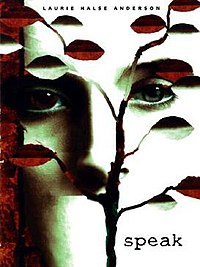
Trying to get a social head start on their high school careers, Melinda and her friends decide to attend an end of the summer high school party. Something horrible happens to Melinda and she calls the police. Her friends and everyone at the school thinks she called to break up the party but they don't know what really happened.
Melinda is forced to suffer in silence. She blames herself at first and has no one to talk to. She has no friends and can't talk to her parents. This is how high school begins for Melinda. She must struggle within to find the strength to confront what happened to her.
I have to admit that this is not a book that I would have chosen on my own. The author conveys Melinda's feeling very well so it was very depressing to read. I would definitely only read this book in a high school class, but I don't know if I would use it as a whole group because of the subject matter. To me this seems like a really good book to have as a book study for a counseling group.
There is also a movie adaptation of this book starring Kristen Stewart. I started watching it but I couldn't finish. From what I did watch, the first 30 minutes or so, it did follow to novel pretty closely.

I agree, it was rather depressing. Small group counseling sounds like a good fit. I watched some of the movie too, but didn't finish either.
ReplyDeleteI have not read this book, and although I agree it sounds depressing, I am now kind of intrigued to read it! High school level sounds like the appropriate age to me as well.
ReplyDeleteAccording to statistics, "A survey of high school students found that one in five had experienced forced sex (rape). Half of these girls told no one about the incident. (5)"
ReplyDeleteThis information was taken from this website: http://www.oneinfourusa.org/statistics.php
I think the problem of sexual assault in High School is much bigger than most of us want to acknowledge and many of these girls do not tell anyone. This book is and was groundbreaking because it broke the silence of this huge group of girls who were suffering alone. It gave them a way to speak about what had happened to them. Most of these girls never end up in counseling situations. What about them? If we shelve this book and only pull it out in small group counseling, what will happen to the one in five that are still silent about what happened to them? Just something to consider. This is one of the reasons for realistic fiction, to encourage discussion. (Dr. White)